
A school–home connection

Parents H-ub

A clearer view of your child's school day. The latest announcements, the thinking behind the MYP, and practical ways to support learning without taking it over.

01 / FAMILY GUIDE

From the student bulletin

These are the same published school announcements your child sees, with additional context for families. Dates, audiences, cancellations and attachments follow the student bulletin; the school announcement remains the source for exact arrangements.

Loading the latest school notices…

The weekly rhythm

Assemblies bring year groups together for announcements and shared expectations. The calendar alongside the student bulletin shows the current weekly notes, including any cancellation. Encourage your child to check it and arrive prepared.

How you can help

Ask “Is there anything this week that needs planning?” rather than managing every reminder for your child. If an arrangement is unclear, use the member of staff named in the announcement.

October 2026

This week

Mon19
Tue20M1 Assembly — 8.30Cancelled
Wed21M2 & M3 Assembly — 8.30Cancelled
Thu22TodayM4 Assembly — 8.30
Fri23M5 Assembly — 8.30
Sat24
Sun25

HAVE A GOOD WEEK

02 / FAMILY GUIDE

Code of Conduct: consistency matters

The school's expectations protect learning, safety and respectful relationships. They cover behaviour, technology, academic integrity, attendance, uniform and campus boundaries. The linked guide summarises the 2026–27 MYP Code of Conduct.

  • Technology: phones are handed in during Homeroom and are not used during the school day, including breaks and lunch. Smartwatches and headphones are not permitted.
  • Respect and safety: reinforce respectful behaviour in person and online, and encourage your child to speak to a trusted adult about bullying or a concern.
  • Integrity: submitted work must be the student's own. Discuss copying, source acknowledgement and whether AI use has been authorised by the teacher.
  • Attendance and routines: follow the school's absence-reporting process and assessment requirements. Check the guide for the specific expectations rather than relying on informal advice.

How you can help

Agree predictable routines for devices, belongings and punctuality. Listen to your child's perspective, then work with their mentor or relevant teacher when a concern needs follow-up.
Read the Code of Conduct

03 / FAMILY GUIDE

M3 H-Assessment: learning independence

H-Project 2027 is the school's independent project for M3. It prepares students for the habits needed later in the M5 Personal Project, but it is a separate school project. Students develop an investigation question, create a product, choose an IB Learner Profile attribute to develop, and connect skills from at least five subjects.

A · The Goal

A clear investigation question and a reasoned choice of Learner Profile attribute.

B · The Build-up

Research, decisions, problem-solving and evidence of progress in the process journal.

C · The Conclusion

The final presentation and thoughtful reflection on learning and growth.

The handbook begins with November 2026 workshops, followed by research and development, product and reflection work in April, and a grading interview and exhibition in May/June 2027. Use the handbook and current notices for the detailed schedule.

How you can help

Provide time, space and encouragement. Ask how their question has become more focused, what evidence they have collected, and what they will record in their weekly process journal. Help them organise—not write, build or research the project for them.

04 / FAMILY GUIDE

What is Service as Action?

Service as Action (SA) is part of the IB Middle Years Programme. Students put learning into practice by responding to a genuine need in their community. It might involve helping others, raising awareness, supporting inclusion or developing a student-led initiative. It is more than collecting hours or raising money: students consider the purpose, act responsibly and reflect on what they learn.

Good service starts with listening. Students should consider who benefits, how to work respectfully with them, and what difference their action makes. The school determines how activities are approved and recorded; not every activity automatically meets its SA expectations.

How you can help

Ask “What need have you identified?”, “Who have you spoken to?” and “What did you learn?” Help with practical arrangements when appropriate, but leave the initiative and reflection with your child. Confirm any permissions or school requirements with the relevant staff member.

Student-led initiatives in the bulletin

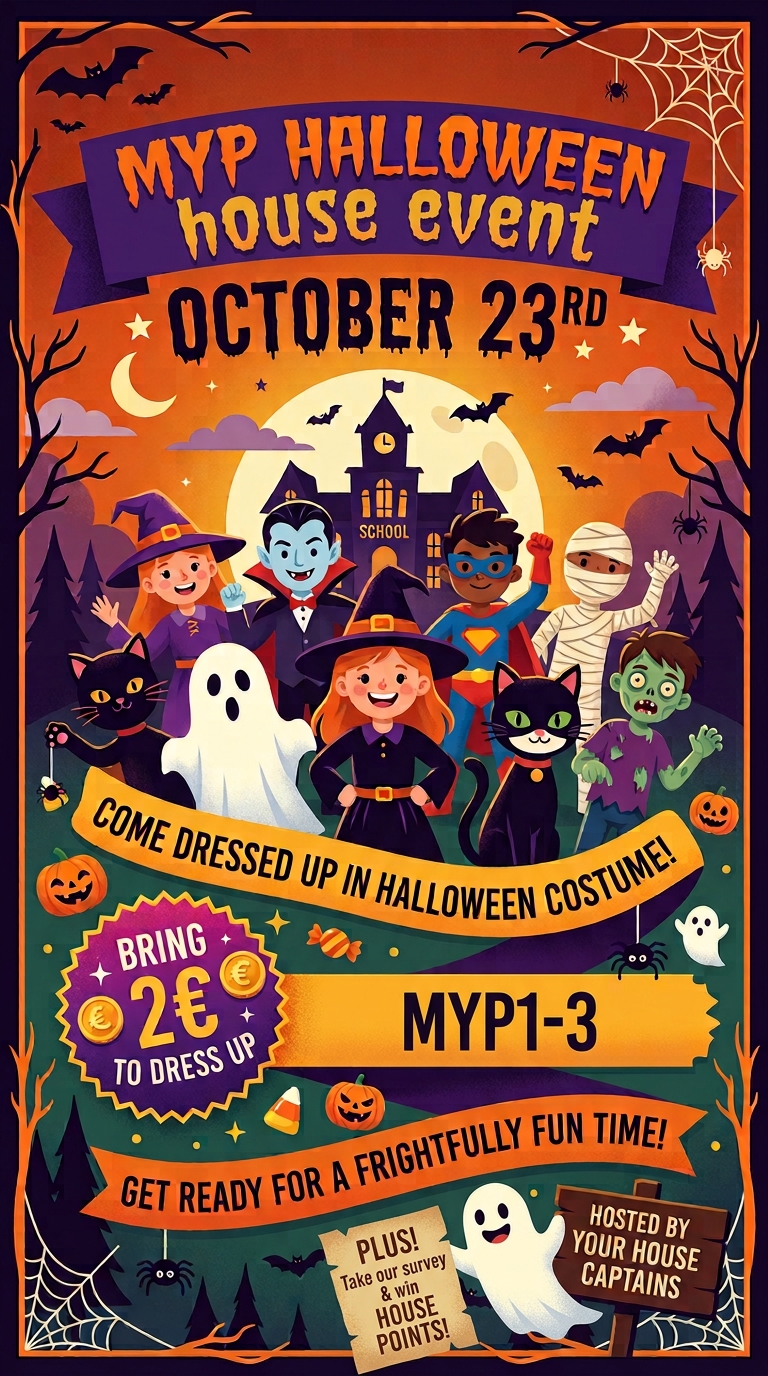
MYP HALLOWEEN HOUSE EVENT poster

MYP HALLOWEEN HOUSE EVENT

Lunchtime runway · In front of reception · MYP 1–3

Wear your spookiest costume on Friday and earn house points. House captains collect €2 today and tomorrow morning. Group costumes are welcome. Hosted by the House Captain Team.

LILT UPDATE poster

LILT UPDATE

Breast cancer awareness week.

Pink bracelets are now 50 cents at the printing desk. Please support the donation box at the front office window. The LILT talk is in early November, with a translator if needed.

05 / FAMILY GUIDE

Student council: a voice, not just a title

A student council represents student perspectives and brings constructive ideas to staff. Representatives listen to their peers, discuss priorities, and help develop improvements or activities for the school community. It gives students practice in communication, collaboration and responsible leadership.

The council is not a substitute for speaking directly to a teacher about an individual learning concern, or to a trusted adult about safety and wellbeing. Election details, roles and current opportunities should be checked in the school's announcements.

How you can help

Encourage your child to explain an idea clearly: what is the issue, who is affected, and what would a realistic solution look like? Remind them that representing others means listening to views different from their own.

06 / FAMILY GUIDE

Understanding IB assessment criteria

MYP assessment is criterion-related: teachers judge work against published descriptions of achievement, rather than ranking students against classmates. In most MYP subjects there are four criteria, A–D, each assessed on a scale from 0 to 8. The names and skills differ by subject, so “Criterion B” does not mean the same thing in every classroom.

Reading a criterion score
LevelWhat to look at
0The work has not met the standard described in the 1–2 band.
1–2 / 3–4 / 5–6 / 7–8These are achievement bands. Read the descriptor and the task-specific clarification to see what the student demonstrated.
Overall 1–7 gradeThis is a different scale. Teachers use criterion totals and IB grade boundaries to arrive at an overall subject grade; it is not simply a percentage or an average of individual task grades.

Subject criteria assess different dimensions of learning, such as knowledge, investigation, communication or application. The M3 H-Assessment and M5 Personal Project each use three project criteria, not the four-criterion subject model.

How you can help

Ask to see the rubric and teacher feedback. Focus on one specific next step: “What would stronger evidence look like?” or “Which part of the descriptor are you working towards?” If a grade is unclear, ask the subject teacher to explain the evidence behind it.

07 / FAMILY GUIDE

The M5 Personal Project

The IB MYP Personal Project is a substantial, student-led project in the final year of the programme. Students choose an area of personal interest, set a learning goal, develop a product or outcome, and reflect on both their learning and the result. A supervisor supports the process, but ownership stays with the student.

A · Planning

Define the learning goal, intended product, success criteria and a plan.

B · Applying skills

Explain how approaches to learning (ATL) skills helped achieve the learning goal and the product.

C · Reflecting

Explain the project's impact on learning and evaluate the product against the success criteria.

The project includes evidence of the process and a report, not just a finished object. The school provides its own deadlines, submission instructions and supervisor arrangements; check these with your child's supervisor rather than assuming the M3 handbook applies to M5.

How you can help

  • Agree realistic milestones and regular check-ins, while allowing your child to manage the plan.
  • Offer access to safe materials or suitable contacts, with school approval where needed.
  • Ask open questions and help them think through setbacks; do not create the product, write the report or rewrite their reflections.
  • Encourage a record of decisions, sources and feedback, including appropriate acknowledgement of any assistance.
  • Contact the supervisor early if progress, wellbeing or practical barriers become a concern.

08 / FAMILY GUIDE

Beyond the classroom

Clubs and belonging

Clubs give students space to explore interests, build friendships and practise commitment. Ask your child what they would like to try and discuss which options fit their interests and routine. Confirm eligibility and any practical arrangements before signing up.

Acceleration Lab

Acceleration Lab invites students to take an idea and develop it into a small start-up. Working in teams, they move through five practical plans and finish the journey at Demo Night, where they present their ideas to a real audience.

  1. 1Idea. A problem worth solving, described clearly and simply.
  2. 2Market research. Finding out who the idea is for and whether people would genuinely use it.
  3. 3Marketing plan. Deciding how the idea reaches the right people and what makes it different.
  4. 4Financial plan. Understanding costs, price and what it takes to keep the idea going.
  5. 5Pitch. Explaining the idea clearly and confidently in a short presentation at Demo Night.

How you can help

Ask what problem their start-up solves and who it is for. Encourage them to gather evidence, listen to feedback and revise the plan. Help with practice runs and practical questions rather than building the pitch for them.

The house community

Atlas, Dolomites, Rockies and Himalayas are the school's four houses. The house system gives students a shared identity and opportunities to participate, contribute and lead. Encourage involvement and good sportsmanship rather than focusing only on winning.

View the houses

Learning habits

The IB Learner Profile describes the qualities the programme aims to develop, including curiosity, reflection, integrity and care. Help your child notice these qualities in everyday choices and make connections between their subjects.

A conversation beyond school

The bulletin's news and history offer starting points for a wider conversation. Ask your child what interested them, what questions it raises and how they would check a claim against reliable sources.

GLOBAL NEWS

NEWS IN BRIEF

Read the bulletin stories
World · Russia signals readiness for peace talks

Russia says it is willing to resume talks with Ukraine and the US in November. No peace agreement has been reached. Read more

Sport · Champions League: goals galore

PSG beat Barcelona 4–2, while Liverpool came from two goals down to edge Villarreal 4–3. Manchester City won 5–1 against AEK Athens. On Wednesday, Bayern and Arsenal drew 2–2, and Real Madrid beat Leipzig 4–1. Read more

OCTOBER 22

ON THIS DAY

  • 1797 · Parachuting

    André-Jacques Garnerin parachuted safely from a balloon over Paris. Source ↗

  • 1811 · Birthday

    Piano virtuoso and composer Franz Liszt was born. Source ↗

  • 1884 · Navigation

    Greenwich was chosen as zero degrees longitude — the starting line for the world's maps. Source ↗

  • 1906 · Remembering

    French artist Paul Cézanne died, leaving paintings that helped shape modern art. Source ↗

  • 1949 · Birthday

    Arsène Wenger, the long-serving Arsenal football manager, was born. Source ↗

  • 1968 · Space

    Apollo 7 splashed down safely after its crewed mission in Earth orbit. Source ↗